
Solar Panels at SJC
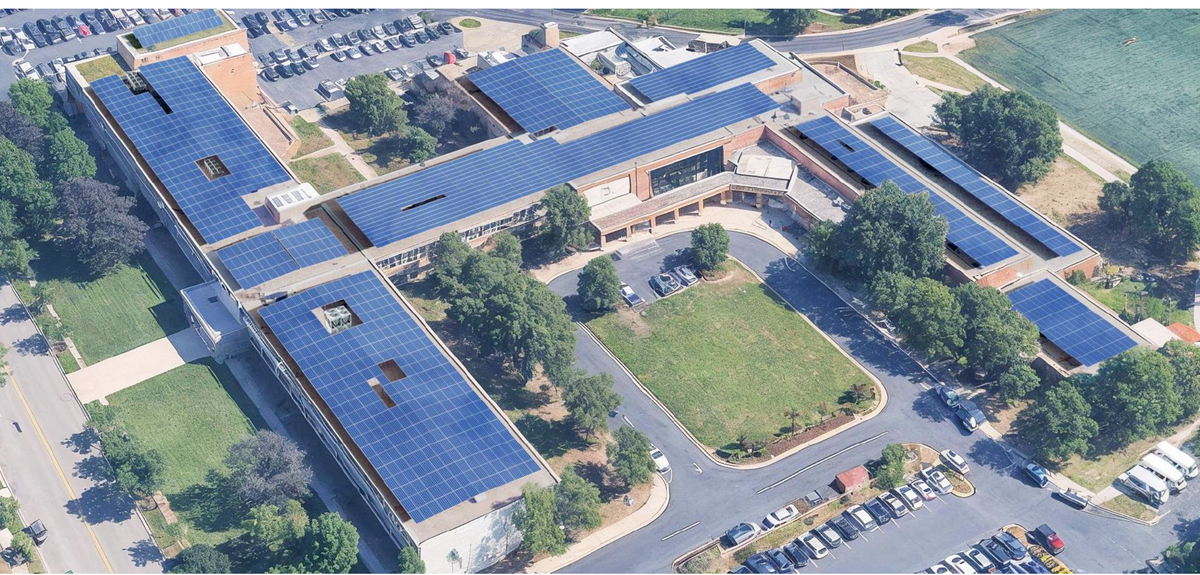
St. John's College High School is putting the sun to work. Over the summer, crews installed nearly 1,500 kilowatts of solar panel capacity across the roofs of the school's two main buildings, a project school leaders say will cut the school's electricity draw from Pepco by more than 50% and pay for itself within five years.
Why solar?
Two reasons came up repeatedly: money and community responsibility.
"We think solar panels at St. John's are really advancing our technology as a school," the SJC eco club said in a statement to The Sabre. "Having this renewable energy is going to benefit us and make our school day-to-day life more sustainable."
The school is self-funding the project for roughly $5 million, choosing to own its solar system outright rather than lease roof space to a third-party solar company, a common alternative that requires little or no upfront cost but yields smaller long-term returns. "We feel like it's better for us to own our own solar, just like we own our own building," Mr. Griffin, SJC's Chief Operating Officer, said. "Over the long trajectory, there's significantly more value." The school expects to recoup its full investment within five years and then net roughly $1 million per year after that money, leaders say will go toward financial aid, faculty retention, and other operating needs. Looking at a 25-year horizon, they describe the return on investment as substantial.
School leaders repeatedly framed the project as both a business decision and a values decision, tying it to the school's approaching 175th anniversary. As Mr. Griffin put it, "We're going to serve it like a mission, but we're going to run it like a business". Being an early mover has also put the school in an unexpected leadership position as two other Catholic institutions had reached out recently asking how St. John's pulled off the project.
What is Happening?
Workers have installed solar panel arrays across both of the school's buildings: 543.39 kilowatts on the North Building (the gymnasium) and 947.54 kilowatts on the South Building (main building), for a combined 1,491 kilowatts of capacity. School officials project the system will cut the school's electricity draw from Pepco by 68 percent.
Because the school chose not to install battery storage, the system works by feeding directly into the electrical grid rather than storing power on-site. On sunny days when the school isn't using much electricity, like weekends and during the summer, the system sends surplus power back to the grid. On cloudier days, or when the building is drawing more power than the panels are producing, the school pulls power from the grid as usual. Mr. Griffin described it as a balance. "On sunny days and full operation, we're basically equal, but on days we don't have as much production, we might be pulling more off the grid," Griffin said.
The environmental payoff, according to figures the school provided, is substantial: the system is projected to offset 1,463 tons of CO2 annually, equivalent to taking 315 passenger vehicles off the road for a year or avoiding the emissions from burning 165,000 gallons of gasoline.
Who led the charge?
The decision ran through the school's full leadership structure. School President Mr. Kevin Haley set the overall vision, and the board of trustees signed off on the project. Chief Financial Officer Mr. Rob Woods built and vetted the financial model to make sure the investment wouldn't come at the expense of financial aid or operating costs.
Mr. Griffin and facilities director Mr. Erin May made it very clear that keeping the project invisible to students and running as smoothly as possible was treated as a measure of success. "We don't want to disrupt the student experience," Mr. Griffin said. McKayla Phillips '28 said, "Honestly, I feel like I can't really tell that there's any construction going on."
On the ground, facilities director Mr. May has led execution of the installation — coordinating contractors, monitoring weather-related safety issues (including a lightning-detection system that can shut work down when storms are within 10 miles), and managing structural and electrical inspections. Describing the scope of the undertaking, Mr. Griffin said, "This is not a simple little paint the classroom project. This is a very advanced technical project."
Where are the Solar Panels?
The panels sit atop St. John's two main campus buildings, which school leaders say gave them an unusually strong case for solar in the first place. "There's nobody that has better opportunity for solar than we do because of the roof," Mr. Griffin said noting the campus sits at one of the highest points in the city with no trees or buildings blocking the sun. The project also needed sign-off beyond the school itself: because the campus borders Rock Creek Park, the design had to go through the local Advisory Neighborhood Commission (ANC). ANC commissioner Bruce Sherman supported the project, which school leaders say made the approval process smoother.
How long did the planning take?
The idea itself isn't new, the school says it has revisited solar "a couple different years in the decades" going back through its history. Serious, active planning for this specific project began last November, when the school started finalizing contracts and securing installation crews. Physical installation began as soon as the school year ended in the summer, timed deliberately so the bulk of the noisy, disruptive work, panel and post installation, electrical runs, connectivity checks, would happen while students were away. Once the school year resumed, remaining work was pushed to after-school hours, after 3pm and to lower-traffic areas of campus.
The installation phase is expected to wrap up by November, though the system won't be fully activated and connected to the grid until around March.
As SJC celebrates 175 years in the DC community, the leaders of our school are working to celebrate the past while looking towards the future.